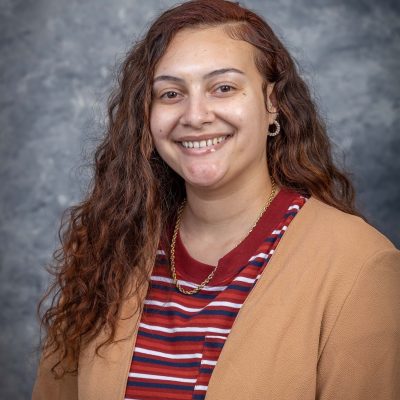

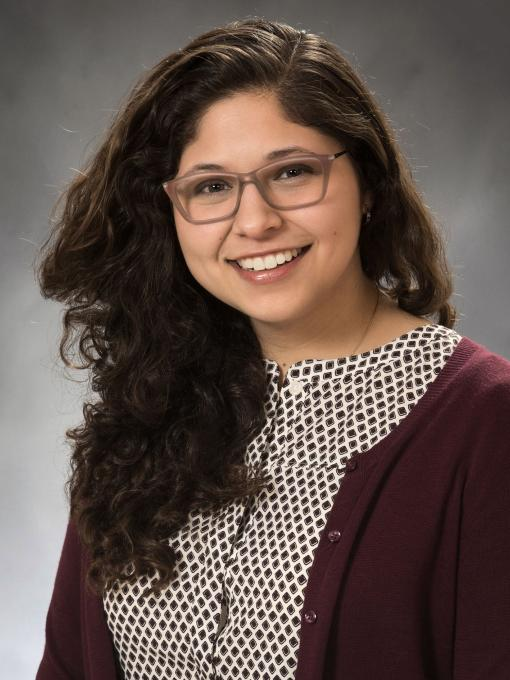
Our Featured Fellow for September 2026 is Denise Chavez Reyes (she/her/ella), a doctoral candidate in the Department of Geography and Geospatial Sciences at Kansas State University. Denise’s dissertation research assesses the ability of agricultural communities to cope with natural hazards. Her broader research interests are diverse, ranging from characterizing indoor and outdoor air quality with a Global Positioning System-enabled monitor to identifying factors that motivate minority groups to pursue higher education.
Denise’s lived experiences have led her toward evolving educational pursuits. During her undergraduate program Denise was visiting a rural town in northeast Tennessee, when she noticed a stone “structure” in the yard that had collected rainwater. Her immediate reaction was to empty it. Little did she know that the structure was a birdbath, and the water had been deliberately placed there. She explains that, for years, it had been ingrained in her to drain standing water because it can serve as a breeding ground for mosquitoes. Coming from a tropical city, there was a high risk of being bitten by Aedes mosquitoes. Her local Public Health Department had educated community members on ways to reduce that risk, including eliminating places where mosquitoes could lay their eggs, such as water collected in that very stone “structure.” Public health educators’ ability to identify ways to reduce disease risk and effectively communicate those strategies to the public sparked her interest in protecting communities, not only from disease vectors but also from climate events and environmental exposures.
This goal of contributing to healthier communities motivated Denise to complete her bachelor’s in Human Services and a Master of Public Health at East Tennessee State University. While sitting in her introductory epidemiology course, she learned how John Snow demonstrated that cholera was being spread through water contaminated with sewage. This early exposure to geographic thought and methods as a way of solving public health crises motivated Denise to learn more about geography. Now a PhD candidate in this field, Denise is starting her fifth year and is expected to graduate in December 2026 under the guidance of Dr. Katherine Nelson (University of Missouri) and Dr. Laura Moley (Kansas State University). Denise’s dissertation focuses on understanding the internal and external validity of composite indicators and exploring the factors that influence whether individuals move from having the capacity to act to taking action.
Denise joined the Bill Anderson Fund as part of the 2024–2025 cohort, where she says that the BAF family served as a safe harbor when the sea waters got too rough. During her first year, Denise served on the Writing Committee, and she now co-chairs the Programming Committee. Through the BAF, Denise has been encouraged to grow professionally and academically. She presented some of her research at the Lightning Talks session in June 2026 at the Natural Hazards Workshop. In July, she participated in the third cohort of Investigations in Disasters and Emergencies: Advancing Applied Learning in Disaster Research Response, an initiative launched by the Center for Disaster Resilient Communities at the University of Washington in partnership with the BAF.
Denise is currently serving as a research assistant in a project examining processes and community engagement related to wildfire building codes in partnership with Headwaters Economics. The project aims to understand the timeline between wildfires and the adoption of WUI building codes, the role of maps in policymaking decisions, and the extent of community involvement in legislative development. This experience has ignited an area of interest not previously known to Denise. Through this work, she came to appreciate how each state’s unique conditions, capacity, resources, and policies influence wildfire risk mitigation. These differences often create systemic barriers to effective mitigation and communication that are worth investigating. The experience has taught her the importance of learning from and partnering with practitioners and renewed her commitment to supporting practitioners in the future.
Outside of academia and work, Denise enjoys walking outdoors, gardening, reading non-fiction books, and experimenting in the kitchen. Sometimes those experiments end up being delicious, others are just barely edible; nonetheless she loves cooking for her loved ones. Post-graduation, she looks forward to doing more of these things, as well as continuing to work with communities whose voices are not always heard and whose needs and capacities are often overlooked, with the goal of helping communities become healthier and more resilient to climate and environmental stressors.