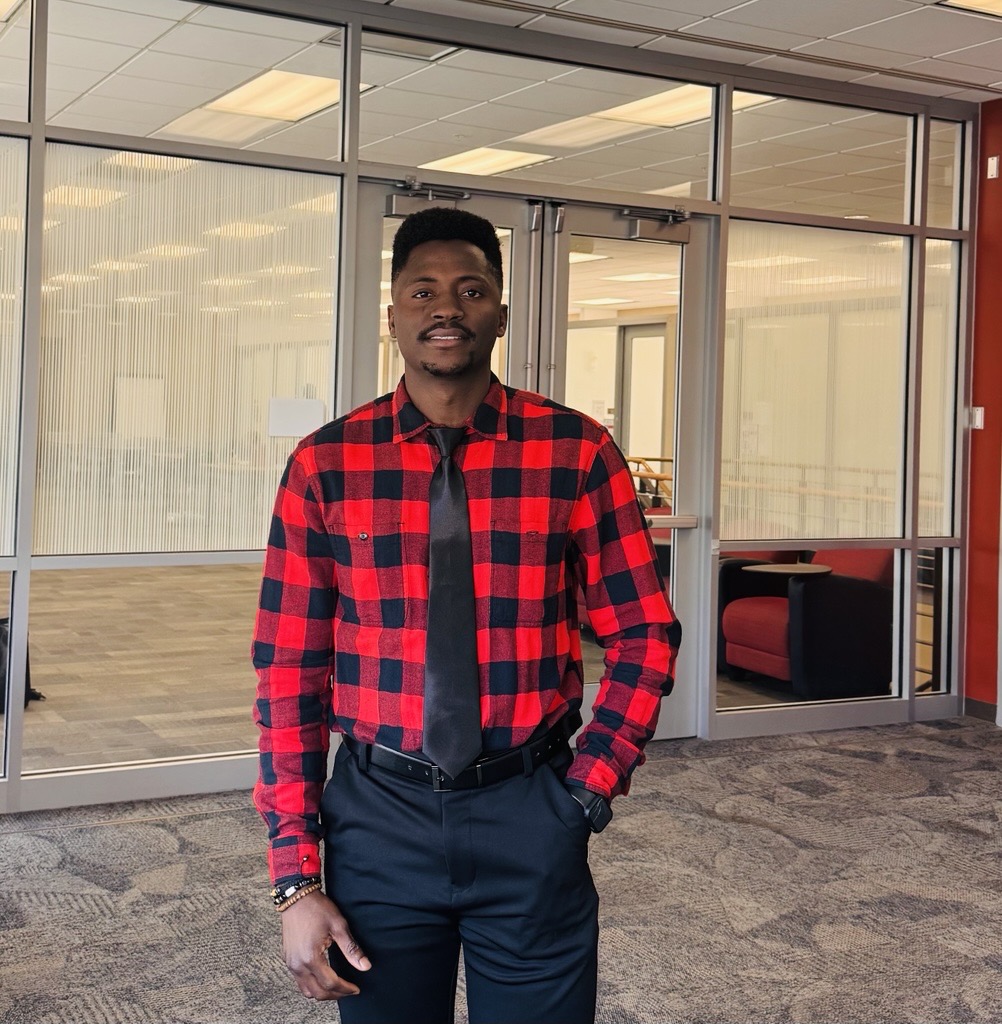
Our Featured Fellow for December 2025 is Afeez Badmus. Afeez is a Ph.D. candidate in civil engineering at the University of Kansas, where he also earned his master’s degree in civil engineering, following a bachelor’s degree in civil engineering from the Federal University of Technology, Akure, Nigeria. Building on this training, his work focuses on multi-hazard resilient infrastructure, experimental testing and monitoring of structural systems, lifecycle benefit–cost analysis, community resilience, and hazard mitigation and policy. His dissertation aims to reduce tornado losses by improving residential building performance through a novel risk-informed framework that integrates structural, social, and economic dimensions of resilience.
Growing up in Lagos, Nigeria, Afeez saw firsthand how fragile the built environment can be. News of building collapses and other structural failures were often reported, claiming lives and disrupting communities. Those experiences stayed with him and sparked his interest in structural engineering and natural hazard mitigation. Understanding why failures occur and how they can be prevented contributed to his passion for designing buildings that can better withstand both natural and human-made hazards. This early exposure now drives his commitment to research that helps make homes and communities safer, especially in places where vulnerability to disaster is high.
Afeez’s current research seeks to improve understanding of how tornado characteristics impact housing and community functioning and to identify accessible, resilient solutions for tornado-prone populations. By linking tornado characterization, structural performance, and household decision-making, his work develops a unified, interdisciplinary methodology for quantifying resilience across physical and social domains. It provides new insight into how windstorm effects propagate from individual wood-frame housing components to community-wide losses and establishes a probabilistic, lifecycle-based framework for evaluating the economic justification of tornado-resistant design. The outcomes are expected to inform updates to residential building codes and mitigation policies, equipping decision-makers with cost-effective, evidence-based tools to reduce long-term risk.
Beyond his research, Afeez is committed to mentoring and community-building. He has supported younger students both undergraduate and graduate as they navigate school, international study, and research careers, and he enjoys creating spaces where students can share experiences and opportunities. His long-term goal is to build a career at the intersection of academia and practice, advancing research on multi-hazard resilience while collaborating with agencies, practitioners, and communities to translate that work into safer, more just outcomes on the ground.
Afeez joined the Bill Anderson Fund (BAF) as a Fellow in 2023. Since then, he has been an active member of the BAF community and currently serves as Chair of the Culture Committee. In this role, he helps foster a positive, inclusive environment within the Fellowship and develops activities that allow Fellows to connect with one another personally and intellectually, supporting their academic progress and wellbeing.
Looking ahead, Afeez is excited to expand his work into multi-hazard resilience, shelter access and human behavior during warnings, and community-informed metrics for recovery and mitigation. Across these interests, his guiding question is simple: How can engineering and policy decisions meaningfully reduce disaster impacts for the communities who bear the greatest risk?