I spent this summer in Eastern North Carolina asking emergency managers, non-profit directors, and community leaders a question that made some of them squirm: “Are you trustworthy?” Not whether residents should trust their institution or their role, but whether they personally deserve the trust communities place in them when disasters strike. Six weeks with the Coastal Hazards, Economic Prosperity & Resilience (CHEER) Hub’s 2025 Summer Scholars program, which enabled these encounters, completely shifted my perspective on trust in emergency management.
As a Bill Anderson Fund Fellow studying immigrant vulnerabilities in disasters, I kept running into examples in which institutional distrust created barriers for vulnerable populations accessing help. Instead of just researching community perspectives on trust, I decided to flip the question and examine how leaders assess their own credibility.
The CHEER Experience
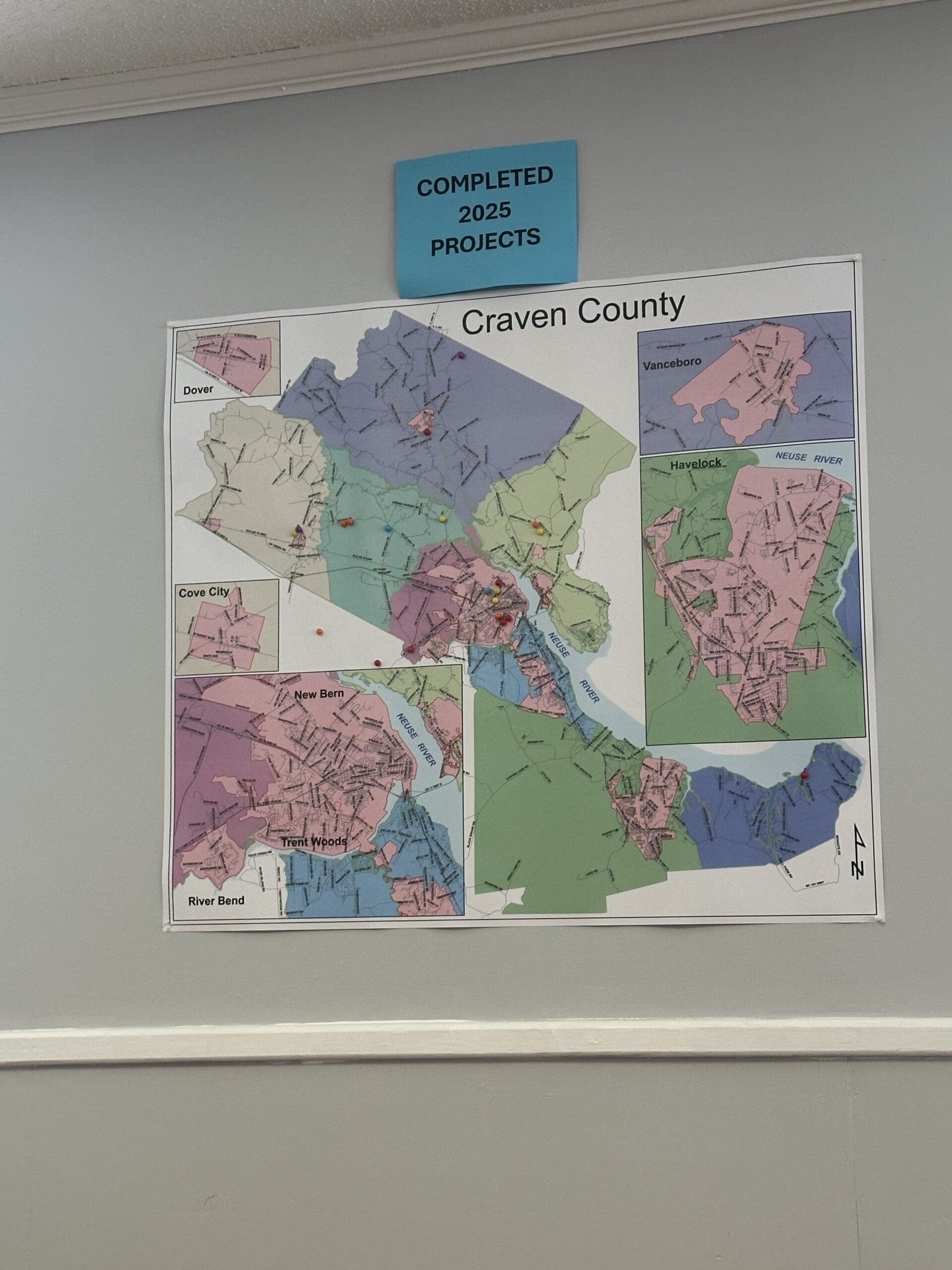
The CHEER program brought together four undergraduate and three graduate students from different universities to conduct fieldwork in one of America’s most hurricane-prone regions. We lived at East Carolina University and spent our days visiting stakeholders across counties that have been hammered by 139 storms since 1900. Our research approach was collaborative rather than individual. During hour-long visits with emergency managers, non-profit directors, and community-based organizations, each of us would ask questions related to our individual projects while everyone contributed to broader conversations. This meant I was asking about self-assessment and trustworthiness while my colleagues explored topics such as infrastructure resilience, economic recovery, and community engagement.
The group format turned out to be invaluable. Listening to discussions about resource allocation and communication challenges gave me context I never would have gotten through solo interviews. My questions about leadership credibility became part of larger conversations about institutional relationships and community dynamics that enriched everyone’s research.
What Leaders Told Me About Their Own Trustworthiness
The leaders we met engaged in much more sophisticated self-evaluation than I expected. When I asked: “What makes YOU trustworthy?” they did not rattle off credentials or point to their official positions. They talked about keeping promises, showing up consistently, communicating honestly, and proving genuine commitment to communities over time.
Government officials had the hardest time with this question. They described having to figure out whether their personal credibility could overcome institutional skepticism that they felt they had inherited from predecessors. Hurricane Floyd’s recovery failures from 1999 still come up in conversations today, forcing current leaders to constantly work to prove they are different. It’s important to note that these were the officials’ own perceptions of their trustworthiness—I did not independently verify these claims with community members, though this would be valuable for future research.
Non-profit leaders evaluated themselves differently. They focused on maintaining independence from political pressures and demonstrating long-term investment in communities rather than just showing up during crises. Individual community leaders comprising people without formal authority, relied entirely on personal qualities like authenticity and consistency.
What struck me most was how these leaders grounded their self-assessments in concrete actions rather than good intentions. They did not claim trustworthiness based on caring about people or having the right motivations. They explained that they evaluated themselves on track records: Had they shown up when needed? Kept every promise? Maintained consistency between what they said and what they did?
The Complications
Working with marginalized populations added layers of complexity that some leaders struggled to articulate. They acknowledged concerns that their race, gender, regional background, or institutional affiliation might create barriers in certain communities. Some admitted feeling less effective with rural populations or specific demographic groups, a recognition that trustworthiness isn’t universal but can vary significantly across different community contexts.
The spread of misinformation emerged as another challenge that forced leaders to question their communication effectiveness. Participants believed that past institutional failures created lasting damage that current leaders have to overcome through individual actions, even when they had nothing to do with those failures. Government distrust runs so deep in some communities that some of the leaders said they had to work twice as hard to establish personal credibility despite their official roles. Others acknowledged that their government badge actually hurt their perceived trustworthiness in certain situations.
These dynamics highlight the critical importance of cultural competency in emergency management. Trust barriers often reflect deeper historical patterns of marginalization, and leaders who recognize these complexities are better positioned to build authentic relationships across diverse communities.
How This Changed My Research Approach
This experience fundamentally strengthened my approach as a researcher in several ways. First, it taught me that examining self-reflection offers a complementary perspective to studying external perceptions, not necessarily a more truthful one, but a different lens that reveals how leaders conceptualize their own roles and responsibilities. The collaborative visit format created opportunities for multifaceted conversations that revealed the complexity of trust relationships in ways that individual interviews might not capture.
More importantly, this fieldwork taught me to approach research questions from multiple angles rather than assuming any single perspective provides complete answers. While leaders’ self-assessments gave me insights into their thought processes and decision-making frameworks, I now understand that comprehensive research on trust requires triangulating these perspectives with community voices, institutional outcomes, and historical context.
The research also refined my theoretical approach. Using organizational trust frameworks to examine self-assessment rather than external evaluation opened new ways of understanding how leadership credibility is constructed and maintained. This methodological insight directly informs my dissertation research on how trust barriers affect immigrant communities’ access to emergency resources, where I plan to examine both institutional perspectives and community experiences.
Living in hurricane country while studying these dynamics made the stakes real in ways that academic literature could not convey. When emergency managers recommend evacuation, they are asking families to trust expert judgment over their own instincts—a responsibility that demands both competence and humility from those in positions of authority.
What Emergency Management Should Do Now
This summer taught me that trust isn’t something emergency managers can assume or demand—it’s something they must continuously earn and honestly evaluate. The leaders most committed to earning community trust are those brave enough to keep asking whether they deserve it.
For emergency management as a field, this means three concrete changes:
Make trust self-assessment routine. Emergency management training programs should include structured exercises where leaders examine their own credibility with different community groups. This isn’t about feeling bad, it is about getting better. The same way we drill for hurricanes, we should practice examining our own blind spots and biases.
Prioritize cultural competency as an operational skill, not just a checkbox. Leaders need frameworks for building authentic relationships across diverse communities, especially immigrant populations who may have complicated relationships with government authority. This means investing time in communities before disasters strike, not just showing up when people need help.
Acknowledge that one size doesn’t fit all. The government official who struggles to connect with undocumented families might partner with community leaders who’ve already earned that trust. Effective emergency management means recognizing when to step back and when to amplify voices that communities recognize through existing communication channels.
The six weeks in North Carolina taught me that building trust requires continuous self-examination. But more importantly, it showed me that when leaders are willing to ask hard questions about their own effectiveness, they become more effective leaders. That uncomfortable ten-second pause I witnessed. That was the sound of someone becoming better at their job.
Acknowledgments
This research was made possible through the Coastal Hazards, Economic Prosperity & Resilience (CHEER) Hub’s 2025 Summer Scholars program. The author thanks fellow Summer Scholars and program leadership for their collaborative approach to fieldwork and the insights gained through shared research experiences. Support for the CHEER Hub and Summer Scholars program is provided by the National Science Foundation.
The author also acknowledges the emergency managers, nonprofit directors, and community leaders in Eastern North Carolina who generously shared their time and perspectives during this research. Yvonne Appiah Dadson is a doctoral candidate in Information Sciences at the University at Albany, State University of New York, and a Bill Anderson Fund Fellow. Her research focuses on socially vulnerable populations, specifically immigrant communities, and their experiences with disasters and emergency management systems. Broadly speaking, her research interests are in understanding how trust barriers affect marginalized communities’ access to emergency resources and disaster recovery services. Currently, Yvonne’s research examines the intersection of immigrant vulnerability, community trust dynamics, and emergency management effectiveness. Her research interests intersect with disaster sociology, immigrant integration, information science, privacy concerns, artificial intelligence in higher education, and community resilience.